





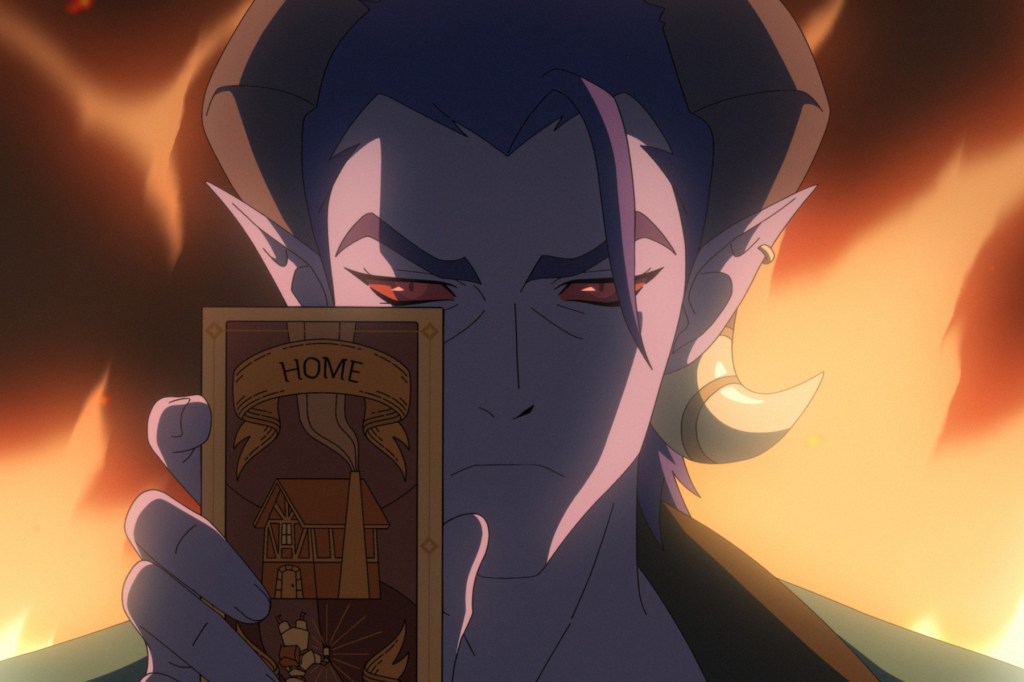

The World of The Mighty Nein
In the fantastical realm of The Mighty Nein, a powerful archmage serving a corrupt empire has stolen a sacred magical relic from a shadowy rival kingdom. This theft threatens to plunge the world into war, and the only hope for salvation lies with a group of misfit heroes, each grappling with their own personal demons. These include the influence of an eldritch ocean leviathan, a would-be wizard assassin, and a chaos-loving god who is mysteriously absent.
This story was first brought to life in Critical Role, a wildly popular actual play Dungeons & Dragons series. The narrative was crafted through the storytelling of Dungeon Master Matthew Mercer, using miniature models and the power of imagination. However, translating this epic tale into an animated series for Prime Video required a more complex approach.
The Challenges of Animation
Sam Riegel, a founding member of the Critical Role cast and one of the executive producers of the animated series, explains that bringing such a story to life on screen isn’t as simple as drawing an army. “It turns out you can’t just draw an army, because they have to draw each one of those little guys,” he says. Fortunately, The Mighty Nein and its predecessor, The Legend of Vox Machina, are being developed by a team up to the task. Riegel and his fellow producer Travis Willingham are working at Titmouse Inc., an animation studio in Burbank, where the walls are lined with Dungeons & Dragons miniatures—goblins, rustic inns, and towering pink mushrooms. While these figurines aren’t directly related to The Mighty Nein or Vox Machina, they reflect the studio’s passion for the game.
A New Beginning
The first season of The Mighty Nein, which premiered on November 19, follows the titular adventuring party from Critical Role’s second campaign, which ran from 2018 to 2021. Compared to Vox Machina, this adaptation is significantly more complex. Rather than starting with the group in a tavern, as many D&D campaigns do, The Mighty Nein takes a slower, more deliberate approach. It’s not until the third episode that most of the protagonists are together, and even then, there’s a character named Yasha, a barbarian warrior, who is absent.
“We very intentionally started with more of a session zero perspective,” Willingham explains, referencing a common D&D term for the table-setting discussion before the dice-rolling begins. Amazon has already ordered a second season of The Mighty Nein, but given the scale of the story, it will take much more than that to complete the narrative, which took Critical Role hundreds of hours to finish.
A Shared Vision
While The Mighty Nein and Titmouse are embarking on a new journey, this isn’t their first collaboration. Founded in 2000 by Chris and Shannon Prynoski, Titmouse is one of the most prominent independent animation studios, having worked on dozens of shows, including Metalocalypse, The Venture Bros., Big Mouth, and Scavengers Reign. Riegel, a prolific Emmy-nominated voice actor, had already worked with Titmouse on several occasions as a voice director. That’s why, in 2016, he approached Prynoski about the possibility of an animated cartoon.
Prynoski recalls Riegel, who knew Prynoski was a big D&D fan, asking if he was familiar with the live-streamed game Riegel and his friends were running. This was during Critical Role’s early days, but Prynoski was aware of it. Soon after, Riegel, Willingham, and Mercer came for a meeting. “Do you think there’s an animated show in this thing?” Prynoski recalls them asking. “I was like, absolutely.”
A Successful Launch
However, when Critical Role and Prynoski began shopping the series around, nobody was interested. It looked cool, but was there really an audience for a cartoon version of a game they’d already watched people play? Streamers and networks didn’t think so. So in 2019, they turned to Kickstarter, hoping to raise money for a single 22-minute short. It took less than an hour to reach the $750,000 goal, and ultimately raised over $11 million, setting a record for the most-funded TV or film Kickstarter campaign.
“That’s when everybody was like ‘Hey what are you doing with that show?’” Prynoski says. “For Netflix or Amazon, $11 million is nothing. But they do care that there’s an audience.”
Expanding the Universe
Prime Video ordered the series, eventually renewing it for a total of five seasons that will tell the complete story of Critical Role’s first campaign. The Mighty Nein followed suit, and while Prynoski isn’t at liberty to reveal the exact budget Amazon gave them for this new show, he makes it clear that the resources reflect the streamer’s confidence in the series.
That confidence extends to The Mighty Nein, too, though there are some differences between the two series. The Mighty Nein’s episodes are an hour long, twice the length of Vox Machina’s. While the animation style and aesthetic is largely the same, Riegel notes that the characters on The Mighty Nein have slightly more realistic proportions than their counterparts, “because it is a more dark and gritty and grounded story than the hijinks of Vox Machina.”
Another new addition is a “dedicated special effects dude,” as Riegel puts it, who works just with particle and lighting effects and is responsible for the depiction of magic in the series. There was magic in Vox Machina, of course, but since The Mighty Nein is largely about a stolen magical relic and the main antagonist is an evil wizard and former mentor to one of the protagonists, the way the magic is animated and realized was of utmost importance.
A Creative Team
Riegel may have joked that it wasn’t so simple as just drawing an army, but Titmouse’s creatives always had a solution—or better yet, an idea for something new. “I expected them to come back with a lot of ‘You can’t do this, rewrite it.’ I don’t feel like we got a ton of that,” adds Tasha Huo, The Mighty Nein’s showrunner, who describes herself as uniquely qualified because she watched all 500-plus hours of Campaign Two. Not everyone on staff is a Critter, which Prynoski says is a boon since “they can look at the show and not be influenced by emotions that they felt watching the stream.”
“We didn’t necessarily know how we could pull some stuff off, but we knew that we would figure it out as we went and with expert guidance from Titmouse, it would happen because everything that we tried on Vox Machina eventually worked,” Willingham says. “So why wouldn’t it work with this one?”
A Studio with a Unique Identity
Willingham says that the artists at Titmouse share a style—and sense of humor—with Critical Role. There’s a van embedded in a wall off the Titmouse office adorned with a painting by Erol Otus, one of D&D’s earliest illustrators, and the hallways are decorated with hand-painted Ghanaian movie posters—including some they commissioned for their properties. (The one for Legend of Vox Machina is among the more straightforward; a poster for Turbo Fast, a spin-off of a forgotten DreamWorks Animation movie about racing snails, has an overwhelming number of guns.) Prynoski’s office has a secret button that opens up a bookshelf to reveal a secret room, and he says originally he wanted to have a second, even more secret room inside that one until realizing it would be too small and useless to justify the gag.
A Legacy of Innovation
Back in the Nineties, the Prynoskis were living in New York City, and Chris was doing animation for MTV on shows like Daria, Beavis and Butt-Head, and Downtown, a short-lived but critically acclaimed series he created. He eventually moved to Los Angeles, where most of the animation action was, but rather than jump right in, Titmouse began with Prynoski selling T-shirts online and uploading flash cartoons to the site to draw customers in. “In a weird way, we presented ourselves as a direct to consumer company from the beginning,” Prynoski says. The cartoons proved more popular than the shirts, and soon Titmouse was animating several series for Adult Swim, including Metalocalypse and Venture Bros. For a generation of stoned young people, this was their introduction to Titmouse.
“I think it was super lucky during our inception that we were largely making Adult Swim shows that were [15 minutes],” Prynoski says. “Our logo card—with the ‘chirp’ sound—was at the end of every show four times an hour being repeated to the audience.” The network’s commercial bumpers—white text on a black background—would sometimes talk about what was happening behind the scenes, shouting out Titmouse by name, too.
Expanding Beyond Animation
These days, it’s harder to get that type of exposure. (“People don’t usually make it to the end of a show on streaming unless they’re diehards or really bananas,” Prynoski notes.) Still, Titmouse has a reputation amongst animation fans, one that it’s taking active steps to cultivate. Part of that means going beyond just making cartoons. Titmouse sells merch, of course, but there have been some bolder swings—including one that fits in very well with The Mighty Nein’s raunchy D&D-inspired sensibilities. Titmouse just released its first tabletop game, Drunkards, Druggies, & Delinquents, following a successful crowdfunding effort last year. As Prynoski runs a quick session, the loosey-goosey fantasy RPG-meets-drinking game—whose kookily illustrated cards and dice all glow under blacklights—feels oddly like a natural next step for Titmouse.
It’s just a first effort, and one Titmouse learned a lot from. If they make another game, they’ll make sure the box weighs less so they don’t get slammed on shipping costs, for instance. The next major step is a subscription service called Chirp, which is still in the works. Once it’s up and running, fans pay for merch boxes, some of which will be exclusive, as well as access to an exclusive cartoon streaming site. T-shirts, of course, are a part of this. They’ve released books and host events at the studios, too. “We try to do things to make it interesting, not just the cartoons,” Prynoski says.
“But we also love making the cartoons.”