







There aren’t nearly as many Thanksgiving movies as there are Halloween or Christmas movies, but the holiday does have its own unique cinematic offerings. One of the most iconic is Planes, Trains and Automobiles, which is forever associated with Thanksgiving. It’s a great comedy that revolves around Kevin Bacon ruining your Thanksgiving plans, but then bonding with an unlikely (and initially annoying) companion before having the experience make Thanksgiving itself more meaningful. While it may seem a bit flippant, Planes, Trains and Automobiles is undeniably great, and everyone knows it. However, we’re not here for traditional Thanksgiving movies or wholesome stories about family and bonding that could also work as inadvertent Thanksgiving movies.
What’s more interesting at the moment are anti-Thanksgiving movies, some of which specifically explore the darker side of the holiday, while others are just grim family-related dramas that might not be ideal Thanksgiving watches for less obvious reasons.
Marriage Story (2019)
Don’t let the title fool you: Marriage Story is all about divorce, made by Noah Baumbach in a sometimes uncomfortably personal sort of manner. When viewed with a glass-half-full approach, Marriage Story is also about moving on past the divorce process and having some acknowledgment of the times when they were good. However, it doesn’t sugarcoat the roughness of the times that were/are bad.
Both Adam Driver and Scarlett Johansson are phenomenal here, and they kind of have to be since so much of Marriage Story involves their characters getting into heated disagreements and later full-on arguments. It’s grim but also cathartic stuff, and if you (and your family) are feeling especially masochistic and anti-Thanksgiving, you should watch it as part of a depressing triple feature alongside both Kramer vs. Kramer and A Separation.
The Shining (1980)
Based on one of those lovely Stephen King books that wasn’t too long, The Shining is… okay, it’s different from the book, and everyone knows that because it’s infamously different. But at the same time, some of the stuff that was scary in the source material is also scary in the movie, even if Stanley Kubrick seemed keen to rework lots of the story and heighten or diminish certain qualities from the source material.
The Shining is mostly about surviving a dangerous family member, at least when you view it on a surface level. If Thanksgiving sometimes feels like that to you, maybe it would be oddly appropriate? In that case, just, like, pretend it didn’t appear in this ranking or something.
Tokyo Story (1953)
Tokyo Story starts off pretty quiet and maybe even a little peaceful, since that’s Yasujirō Ozu’s style. Some of his movies are indeed pretty gentle, especially the dramedies. But Tokyo Story, though not exactly miserable straight away, does make it apparent pretty early that the focus is going to be on drama, and then the more despairing parts of the movie sneak up on you and get more emotionally intense with time.
It’s long for something that’s also pretty slow, but Tokyo Story is ultimately very heavy in a rather disarming way, being all about a family largely made up of people who don’t seem to have any time for the same family’s eldest members anymore. It is a fantastic film and earns its reputation for being one of the greatest international movies of all time, but it’s heavy-going and even a bit challenging owing to the emotions explored and the very patient pacing.
Die My Love (2025)
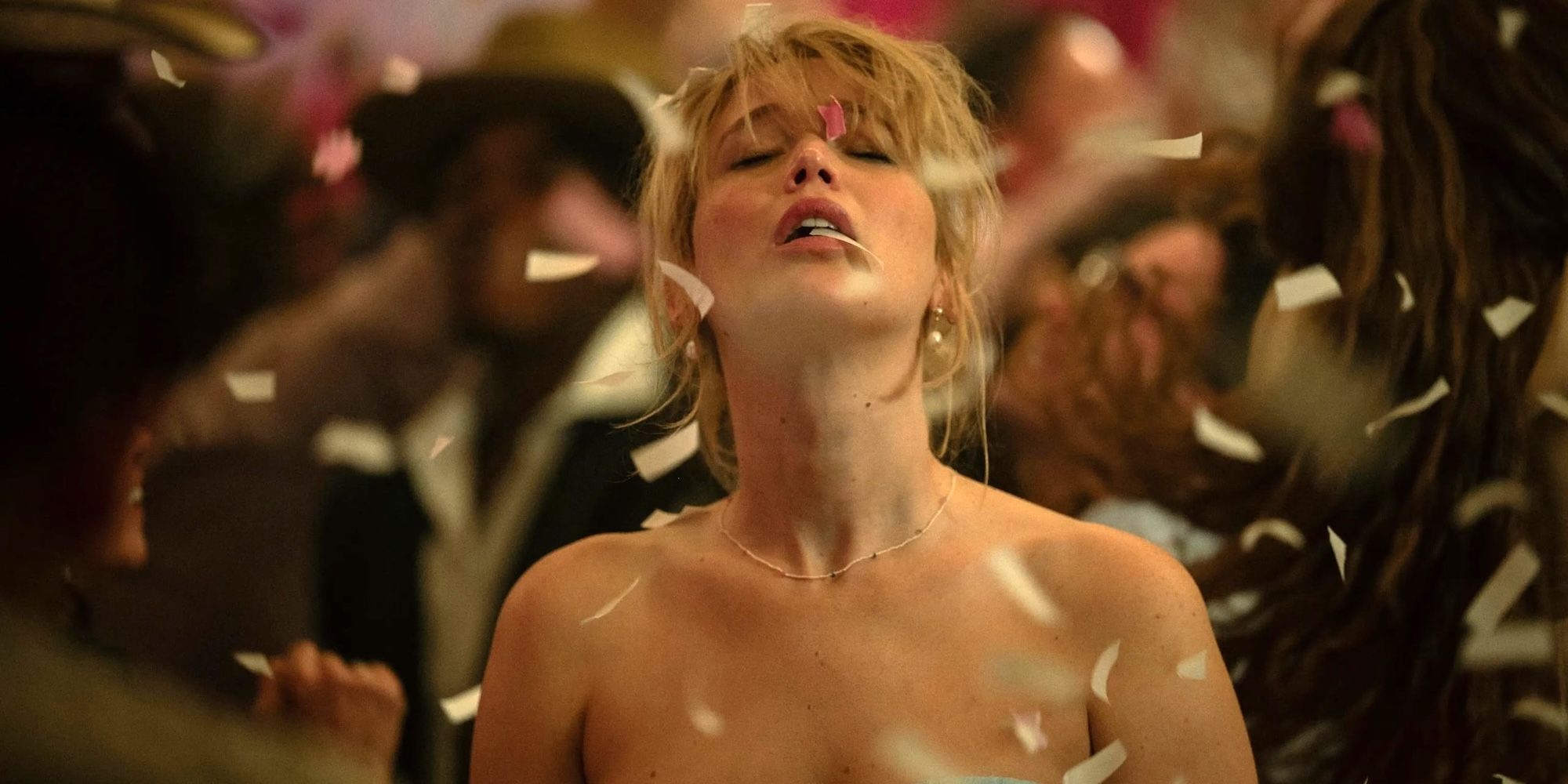
With Die My Love, Jennifer Lawrence and Robert Pattinson both get to go for broke across a messy and continually unsettling two-hour runtime, and one that’s largely plotless, in all honesty. This movie wants to capture a certain kind of psychological instability, and in that sense, it’s very effective at times and certainly visceral, but it confounds (and maybe even disappoints) if you want to approach it as a movie.
It’s a feature-length mental breakdown, really, and Lawrence’s character (the central one) is a young mother who struggles with being left alone with an infant all day and does not seem at ease with the life that’s been thrust upon her. So, in that sense, Die My Love is a very queasy drama/thriller about a fairly small, and young, family falling apart, but not in a linear or even particularly comprehensible way. There are other reasons you might not want to watch this one with family, like, even outside the Thanksgiving period, but it feels particularly inappropriate for that time of the year.
Mommie Dearest (1981)
Well, at least Mommie Dearest isn’t the bland kind of biopic; not really Oscar bait or anything, by any means. Instead, it’s a pretty unstable and chaotic movie about Joan Crawford and the very tumultuous relationship she had with her adopted daughter. The chaos comes about because Mommie Dearest is also pretty camp. Some of that camp feels intentional, and then some of it, it’s a little harder to tell.
Still, even with Mommie Dearest being flawed, Faye Dunaway’s performance, playing Crawford, is brazen and usually pretty easy to appreciate, not to mention perhaps a little over-criticized upon release. Make no mistake: the movie is still a mess, but it might not be terrible in the traditional sense, the way you’ve potentially been led to believe. But considering it’s about horrible things happening within a family, it would be largely terrible to watch during a Thanksgiving period that’s intended to be pleasant and all.
Jack and Jill (2011)
Oh hey, this one is actually about Thanksgiving, and is supposed to be chaotic in a funny way, but it’s not, since it’s one of the worst comedies of all time, and is – regrettably – Jack and Jill. It’s an overly confident movie that asks, “Wouldn’t it be funny if there was a film about Thanksgiving with a pair of twins, and one of the twins was annoying, and both twins were played by Adam Sandler, despite the annoying twin being female?” and it turns out, no, that’s not very funny.
Even among the lesser Adam Sandler films, Jack and Jill is a nadir, and even the morbidly curious should probably steer clear of ever actually sitting through this one. So, it’s not really a family-related film that’s potentially uncomfortable, when watched around Thanksgiving, and instead a movie about Thanksgiving that also potentially happens to be the worst of all the Thanksgiving-related movies.
The Lion in Winter (1968)
The waters are muddied a little when talking about The Lion in Winter as either a Thanksgiving or anti-Thanksgiving movie, since it’s more of an anti (or unconventional) Christmas movie more than anything else. It takes place during that slightly later in the year holiday season and revolves around a kind of succession crisis that sees Henry II, his estranged wife, and his sons all bickering with each other.
Thankfully, it’s very entertaining and well-written bickering, and The Lion in Winter is one of the quintessential movies about a dysfunctional family. Some of it’s funny, and some of it is honestly pretty emotionally harrowing, but it really gets the balance right. The negative stereotype around Thanksgiving, sometimes, is that it’s a time of the year when families get together and conversations get potentially a little heated (blame alcohol, if you want), and The Lion in Winter is a film in line with that kind of negative stereotype, for better or worse.
Krisha (2015)
And to cap things off with one more movie that’s specifically about Thanksgiving, here’s Krisha, which is surprisingly intense, even for a psychological drama. It’s a movie about a family getting together for Thanksgiving, though the titular character is a woman who’s become estranged from said family because of various personal demons, and she tries to attend and bond with them, but things don’t go to plan.
The unraveling happens very slowly, but also in an inevitable sort of way that’s genuinely mortifying – and uncomfortably real – to see play out. Krisha handles heavy themes surrounding trauma, addiction, and some other things in a surprisingly careful way, but it’s also brutally honest about what it wants to unpack. Still, it’s incredibly mature considering how young Trey Edward Shults was when he directed it, but even if the film’s technically good, it does remain quite difficult to recommend broadly.