






A Cinematic Collaboration That Has Evolved Over Two Decades
Rian Johnson’s first film, “Brick,” released 20 years ago, marked the beginning of a long and fruitful partnership with cinematographer Steve Yedlin. For over two decades, the duo has worked together to create visually compelling worlds, whether grounded in gritty realism or painted with the most vibrant colors of the Galaxy. Their latest project, “Wake Up Dead Man: A Knives Out Mystery,” sees them pushing the boundaries of visual storytelling even further.
Yedlin, who has been involved in many of Johnson’s projects since their early days working on shorts, shared his thoughts on the collaboration. “I’m super lucky to have had [Johnson] bring me along for the ride because it started out great, and it’s kind of gotten even better,” he said. “Like, I would be a huge fan of his films even if I didn’t have anything to do with them. So I’m lucky to have gotten involved with him, and he always makes the journey of it so much fun.”
Visual Storytelling and the Art of Lighting
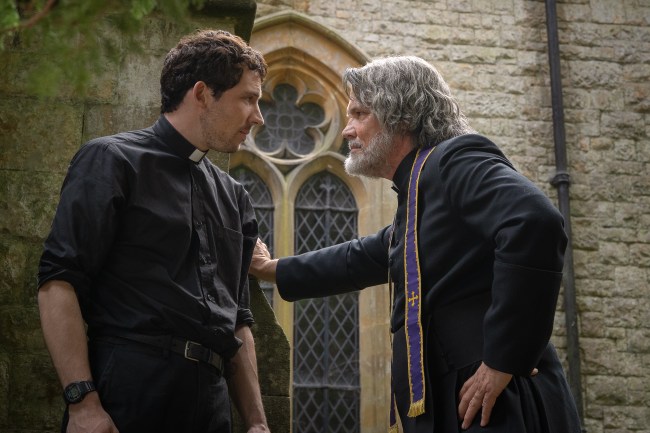
On “Wake Up Dead Man,” Yedlin and Johnson focused on using light to enhance the narrative, particularly in the context of the story’s central character, Father Jud (Josh O’Connor). As the prime suspect in the murder of Monsignor Wicks (Josh Brolin), Jud’s trials are reflected in the film’s visual language. The team also aimed to create a gothic atmosphere that complements the mystery at the heart of the story.

The production design by Rick Heinrichs, especially the church setting, Our Lady of Perpetual Fortitude, played a crucial role in shaping the film’s mood. Yedlin described the church as “my favorite set I’ve ever shot in, period, just in terms of how beautiful the thing he made was and how perfect [it was] for the movie.” The Gothic architecture provided numerous opportunities for creative lighting and camera work.
To achieve the desired visual effects, Yedlin used custom software to control the lighting programmatically. This allowed for both precise timing and flexibility, ensuring that the lighting could adapt to the actors’ performances. “We can make sure that [a lighting cue] starts on this line and takes exactly 32 seconds. It’s very controlled and it can be very complex. But on the other hand, it’s really quick and flexible, and it’s not like once it’s all programmed, we can’t change it,” Yedlin explained.
Capturing the Ensemble Dynamic
One of the challenges of “Wake Up Dead Man” was capturing the dynamic of a large ensemble cast. Yedlin wanted to avoid the typical “90s sitcom” look and instead focus on shots that were expressive of the characters while maintaining the broader context of the group. He emphasized the importance of power dynamics and how the placement of characters in the frame could convey relationships and tensions.
“You don’t want it to feel like it’s just one talking head replacing another, and it’s just a whole bunch of the exact same closeups, because that’s: one, visually boring, and two, that would demand way too many shots,” Yedlin said. “Most importantly, so much of the meaning of having these people together and the feel of the whole thing is based on how they’re all juxtaposed with each other – who’s foregrounded and who’s backgrounded.”
The Power of the Group
While the physical environment of the church contributes to the film’s eerie atmosphere, the true sense of menace comes from the interactions between the characters. Each member of Wicks’ inner circle reinforces the tension, creating a collective force that targets Jud. “It’s about the people inhabiting the space together – both the physical space in the story and the screen space, too,” Yedlin said. “The group is such a character.”

In the world of “Knives Out,” both heaven and hell are represented by the people around us. The film’s success lies in its ability to weave together the personal and the communal, creating a narrative that is as much about relationships as it is about mystery.
More from the source.