










On December 4, the Honors Winter 2025 ceremony will celebrate the creators and stars responsible for crafting some of the year’s best films. Curated and selected by the editorial team, Honors is a celebration of the filmmakers, artisans, and performers behind films well worth toasting. In the days leading up to the Los Angeles event, the platform is showcasing their work with new interviews and tributes from their peers.
Cinematographer Autumn Durald Arkapaw may be behind some of the year’s most striking imagery, but the innovator who combined 65mm IMAX and Super Panavision 70 to create the gorgeous, ambitious large-format photography of “Sinners” never envisioned a career in filmmaking. In high school, she was interested in photography and made short films with her friends, but never considered them a serious pursuit. When she decided to attend Loyola Marymount University, her intention was to study art history. But even though she went to college with no plans to enter the film industry, the seeds had been planted years before.
“I’m from Northern California, and I was raised by a single mom,” Arkapaw said. “She would always take me to movies or watch movies at home. In the back of my mind, she played a big role in giving me a love for movies and going to the theater.”
What turned her adolescent interest in movies into a lifelong passion and ambition was a film course Arkapaw took at LMU to fulfill a curriculum requirement. She wrote a paper on two black-and-white masterpieces: “Raging Bull,” which Michael Chapman shot for Martin Scorsese, and “Broadway Danny Rose,” one of many landmark collaborations between Gordon Willis and Woody Allen.
“It blew my mind open, being in this class talking about how films were shot and what it meant,” Arkapaw said. “I wanted to know who was making these images.” When Arkapaw started researching cinematographers, she was disappointed by the dearth of women in the profession. But she found a few role models, like Ellen Kuras, who shot 2001’s “Blow,” and that was enough to inspire her to dive headfirst into studying and immersing herself in the world of cinematography. “I was hooked,” she said.
After graduating from LMU and spending a few years working in the corporate world, she decided to commit once and for all to pursuing a career in cinematography. Even though it meant trading steady employment for student loans and an uncertain future, when she was accepted into the AFI Conservatory’s cinematography program, Arkapaw left the idea of a life working at a desk behind.
At AFI, Arkapaw got the opportunity to shoot her first feature film when classmate Rafael Palacio Illingworth wrote, directed, and starred in “Macho,” a microbudget dramedy that Arkapaw photographed between her first and second years. “We shot on 35mm and it won an award at Raindance,” Arkapaw said, referring to the U.K. film festival. “That allowed me to become a DP before I graduated.” After graduation, Arkapaw shot another low-budget indie, “Guadalupe the Virgin,” and then she got the call that would lead to one of her most satisfying creative partnerships.
“A classmate of mine at AFI was going to shoot [Gia Coppola’s] ‘Palo Alto,’ and he was unavailable one day and asked me if I could fill in,” Arkapaw said. “Gia was shooting some stuff on a 7D to show [James] Franco – little vignettes with her friends.”
When Arkapaw came on board to photograph the feature, in some ways it felt like starting from scratch – even with two features and several shorts already under her belt. “It felt like my first film because I found a director that I really had a deep connection with. We shared a similar visual language and aesthetic and taste in a lot of things: fashion, food, music,” Arkapaw said, adding that working on a small set, filled with friends, deepened the experience. “It felt very powerful, like I was part of a group and could finally say something with a camera.”
Arkapaw and Coppola became fast friends and began an ongoing collaboration that would lead to last year’s acclaimed “The Last Showgirl,” which earned star Pamela Anderson her first Golden Globe and SAG nominations.
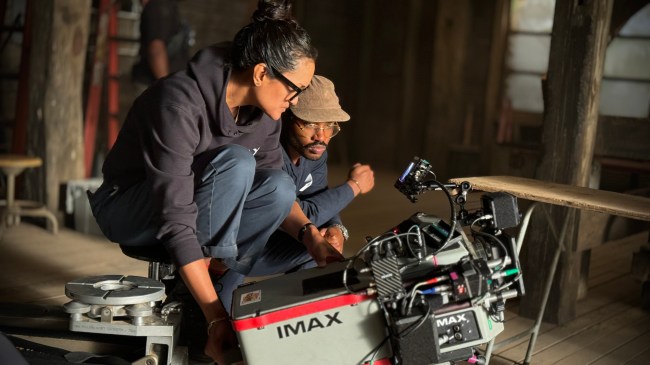
Another filmmaker Arkapaw quickly found a common language with was “Black Panther: Wakanda Forever” and “Sinners” director Ryan Coogler, whom she had initially hoped to work with on the 2015 “Rocky” spinoff, “Creed.” “I’m really good friends with [cinematographer] Bradford Young, and it was Bradford who told Ryan about me when he was looking for a DP for ‘Creed,'” Arkapaw said. “When he brought my name up to the studio, I only had ‘Palo Alto’ as a credit, and it wasn’t enough for the studio to move forward with me. Unfortunately, we were like ships passing in the night.”
Luckily, by the time Coogler needed a director of photography to come on board 2022’s “Wakanda Forever,” Arkapaw had amassed several substantial credits, including work on the Marvel TV series “Loki.” The success of that series put Arkapaw at the top of not only Coogler’s list but also the studio’s, and after her first Zoom call with Coogler, she knew she had met another filmmaking soulmate.
“It felt like we were long lost cousins,” Arkapaw said. “It just felt right, like I was meant to meet him and meant to be a part of that group.” Coogler had already assembled most of his team from people he’d worked with on previous movies, with Arkapaw and the assistant director being the only two new additions. But the cinematographer immediately felt at home. “It’s a daunting thing to come in on the second movie when the first one had such a tight-knit family, but I felt really supported,” she said.
Because “Wakanda Forever” had such a long shoot – around an entire year – Coogler said at the time that Arkapaw was the DP he had worked the most with, even though they had only made one movie together. After “Wakanda Forever,” Coogler and Arkapaw stayed in touch, and the cinematographer began to get hints about their next collaboration. “I knew that he was writing something personal, and that it was a period piece, and that he wanted to shoot it on 16mm,” Arkapaw said.
That project turned out to be “Sinners,” a film that would utilize Arkapaw’s greatest strengths: her impeccable eye, along with her talent for marrying images to music, as seen in her music videos for SZA, Rihanna, the Jonas Brothers, and more. When Arkapaw read Coogler’s ambitious script, she was immediately excited by the range of possibilities and challenges, from mixing genres as disparate as horror movies and musicals to shooting Michael B. Jordan as two distinct characters.
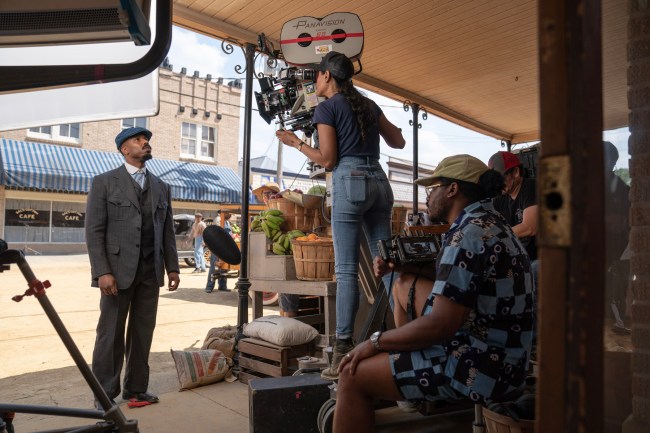

“The first time I read it all the way through, I was blown away,” Arkapaw said. She immediately began talking with Coogler about influences ranging from Paul Thomas Anderson’s “There Will Be Blood” to John Carpenter’s “The Thing,” but her primary inspiration came from a book of photographs by Eudora Welty. “It was a book of black-and-white photos Ryan told me about from the 1930s. I looked at it and knew exactly what he was after visually, and in terms of mood and tone,” she said.
Initially, Coogler planned to return to the 16mm format he had enjoyed working with on “Fruitvale Station,” and Arkapaw was equally excited, given her positive experience with 16mm on “The Last Showgirl.” Early conversations with the film’s visual effects supervisor, however, made Arkapaw realize that the compositing required for Jordan’s twinning shots would be compromised by the smaller gauge format, so the decision was made to go with 35mm. That’s when the studio approached Coogler about shooting large format – resulting in the final 65mm IMAX extravaganza.
“It opened his mind up, and he called me immediately,” Arkapaw said. Coogler floated the extremely wide Ultra Panavision 70 process that Quentin Tarantino used for “The Hateful Eight” – and which had been used on spectacles like “Ben-Hur” and “The Greatest Story Ever Told.” So she began looking at 65mm dailies from a variety of processes and films, running scenes from Tarantino’s 2015 Western, “2001: A Space Odyssey,” “Tenet,” and others at FotoKem. She then went out to the desert to shoot a series of tests with multiple lenses, cameras, and formats, including 35mm.
Eventually, both the cinematographer and director agreed that the clear choice was to shoot “Sinners” alternating between 65mm IMAX and Ultra Panavision 70 – a bold decision given that IMAX boasts one of the tallest possible aspect ratios at 1.43:1, while Ultra Panavision 70 is the widest at 2.76:1.
This made Arkapaw, who once struggled to find female role models, the first woman to shoot on both IMAX film and in Ultra Panavision. (She’s also the only cinematographer to shoot with IMAX Ektachrome film stock, which was created by Kodak especially for “Sinners.”) But Arkapaw was convinced that it was the right decision, which was confirmed when she and Coogler shot more test footage and cut it together to see how the alternating, disparate aspect ratios would work. “I immediately thought it was a great idea,” she said, describing the effect as “beautiful.” “It didn’t cross my mind that it wouldn’t work,” she said.
The approach enabled Arkapaw to achieve a combination of period accuracy and visceral immediacy that was further enhanced by her careful selection of anamorphic lenses. Many of these were engineered specifically for “Sinners” by Panavision lens genius Dan Sasaki, though Arkapaw also “grabbed some other lenses, like the lenses from ‘2001: A Space Odyssey.'” “I gravitate toward older glass generally,” she said. “When you’re working with this format that’s very resolute, they pair nicely, as far as having age and texture to the image, because you want it to look like the 1930s.”
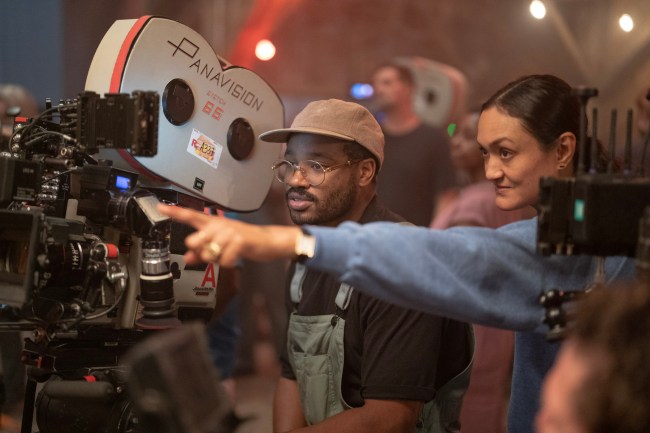
Given the audacious blend of genres and complex thematic layering, the critical and commercial success of “Sinners” was hardly a given, but Arkapaw did have a sense she was working on something unique during production. “It happened even in the tests,” she said. “We did a hair and makeup test, and just seeing Michael in those hats and walking on set – the power of his face – you just got so excited. There were so many moments on set early on where I would look at Ryan, and it would be unspoken: ‘Wow, this is really special.'”
The kind of inspiration she felt while working on “Sinners” is what Arkapaw always aspires to – and what makes her more and more excited about her work as a cinematographer. “All you want as a photographer is to be inspired every time you look through the lens,” she said, “and it was happening constantly on this film for me.”
Arkapaw may not have to wait too long to feel that way again, since she already has another project planned with Coogler and his team: a highly anticipated reboot of “The X-Files.” “I’m excited because I know we’re going to be brave, and I’m going to be with people I like to be around, and they’re going to protect me and let me exercise creativity at the highest level,” she said. “That happens to some people once in a lifetime, but I get to make more projects with this group. I’m very fortunate.”
More from the platform